

Moving to Goodyear, AZ?
Here's How to Buy New Construction the Right Way.
A practical guide for out-of-state buyers — communities, builders, build timelines, what things actually cost, and why having your own agent protects you from day one.
Neighborhoods, commute, climate, schools, and who loves it here.
Every major new-construction community in and around Goodyear.
A phased schedule from initial research through move-in day.
The builder's rep works for the builder. Here's what changes when you have your own.
What Living in Goodyear Is Actually Like
Goodyear sits at the western edge of metropolitan Phoenix, bordered by the Estrella Mountains to the south and the White Tank Mountains to the north. It's not a suburb in the traditional sense — it's a city of roughly 115,000 people with its own commercial core, healthcare infrastructure, entertainment, and a distinct character that draws people back after they visit for the first time.
Location and Commute
Goodyear straddles I-10 and Loop 303, giving residents two major freeway options into Phoenix and north toward Peoria and Surprise. Downtown Phoenix is approximately 25 to 35 miles east — a 30 to 45 minute drive in normal traffic, though peak-hour westbound on I-10 adds time. The Loop 303 has significantly changed commute patterns: heading north gives access to Luke Air Force Base, Peoria, Glendale, and eventually I-17 without touching the 10.
Luke Air Force Base is roughly 15 miles north of central Goodyear, making the area a consistent choice for military families on PCS orders. Employers in the West Valley include Amazon, Lockheed Martin, REI, Coldwater Creek distribution, and a growing medical corridor anchored by Cancer Treatment Centers of America (CTCA) at Western Regional Medical Center, which is located in Goodyear and draws patients and healthcare workers from around the country.
For remote workers, Goodyear's combination of home size, cost per square foot, and infrastructure makes it one of the more practical choices in the Phoenix metro. Fiber internet is widely available in newer communities.
Climate
Summers are hot. Phoenix metro averages stretch well above 100°F from June through September, with July being the hottest month. If you are relocating from the Pacific Northwest or the Midwest, the first Arizona summer is a real adjustment. The tradeoff is 300+ days of sunshine annually and winters that are genuinely mild — daytime highs in the 60s and 70s from November through March, with occasional nights dipping near freezing.
Monsoon season runs July through September, bringing brief, intense afternoon storms that can produce dramatic lightning, localized flooding, and dust storms (haboobs). Most homes in Goodyear's newer communities are built with this in mind — proper drainage, sealed construction, and desert landscaping designed to handle the runoff.
The heat is the number one concern new residents mention — and the thing most of them say they adapted to faster than expected, especially once they have a well-designed home with a good AC system and a covered patio or pool.
Schools
Goodyear is served primarily by the Litchfield Elementary School District and Agua Fria Union High School District, along with portions of the Estrella Mountain Elementary School District and Buckeye Union High School District in the southern and western reaches. Ratings vary by campus; several elementary schools in established West Valley communities hold strong reputations. Verify boundaries for any specific community before signing — school district lines do not always follow city limits here.
Charter and private options include BASIS Goodyear, Veritas Preparatory Academy, and several faith-based schools. The Estrella Mountain Community College campus is in Avondale, immediately adjacent to Goodyear, and ASU's West campus is about 20 miles north in Glendale.
Healthcare
Cancer Treatment Centers of America at Western Regional Medical Center is one of Goodyear's most recognized institutions — a nationally known specialty cancer hospital that also brings a concentration of affiliated specialists and outpatient services to the area. Banner Estrella Medical Center serves the broader West Valley. The area has expanded its urgent care and outpatient specialist network substantially over the past several years as the population has grown.
Shopping, Dining, and Recreation
Estrella Falls is Goodyear's primary retail hub — a large open-air center on Camelback Road with major anchors, restaurants, and entertainment. Downtown Goodyear along Litchfield Road has a more local character. Goodyear Ballpark hosts Cleveland Guardians and Cincinnati Reds spring training, which gives the area a distinct seasonal energy in February and March.
The Estrella Mountain Regional Park offers over 17,000 acres of trails, equestrian paths, and desert wilderness within minutes of most Goodyear communities. The White Tank Mountain Regional Park is accessible from the north side. Fishing, boating, and kayaking are available at Estrella Lake within the master-planned Estrella community itself.
Who Loves It Here
- Military families at Luke AFB who want a newer home without the premium of Scottsdale or Chandler pricing.
- Remote workers from California and the Pacific Northwest looking for a significantly larger home at a fraction of the cost, without giving up access to a major city.
- Families with children drawn to master-planned communities with parks, trails, and resort-style amenities that are built in, not added later.
- Retirees and snowbirds attracted by Del Webb at Estrella and other active-adult communities, the climate, and the lower Arizona cost of living.
- Healthcare workers affiliated with CTCA, Banner Estrella, and the broader West Valley medical corridor.
Goodyear New Home Communities and Builders
Goodyear and the immediately adjacent West Valley cities have some of the most active new-construction markets in the country. Here's an honest overview of the major communities and what each one offers — including builders currently active in each.
Estrella
Master PlanOne of the largest and most established master-planned communities in the West Valley. Estrella spans thousands of acres in the southern end of Goodyear, bordered by the Estrella Mountain foothills. The community features two lakes — including the well-known Estrella Lake — miles of trails, two resident-only Starpointe recreation centers, fishing, kayaking, and an active HOA with strong community programming.
Estrella has multiple villages (Montecito, Portales, Sonoran Foothills, and others), each with its own feel and price range. New construction is ongoing in the southern phases. Del Webb at Estrella is the active-adult 55+ village within the community — one of the most sought-after retirement addresses in the West Valley.
Palm Valley
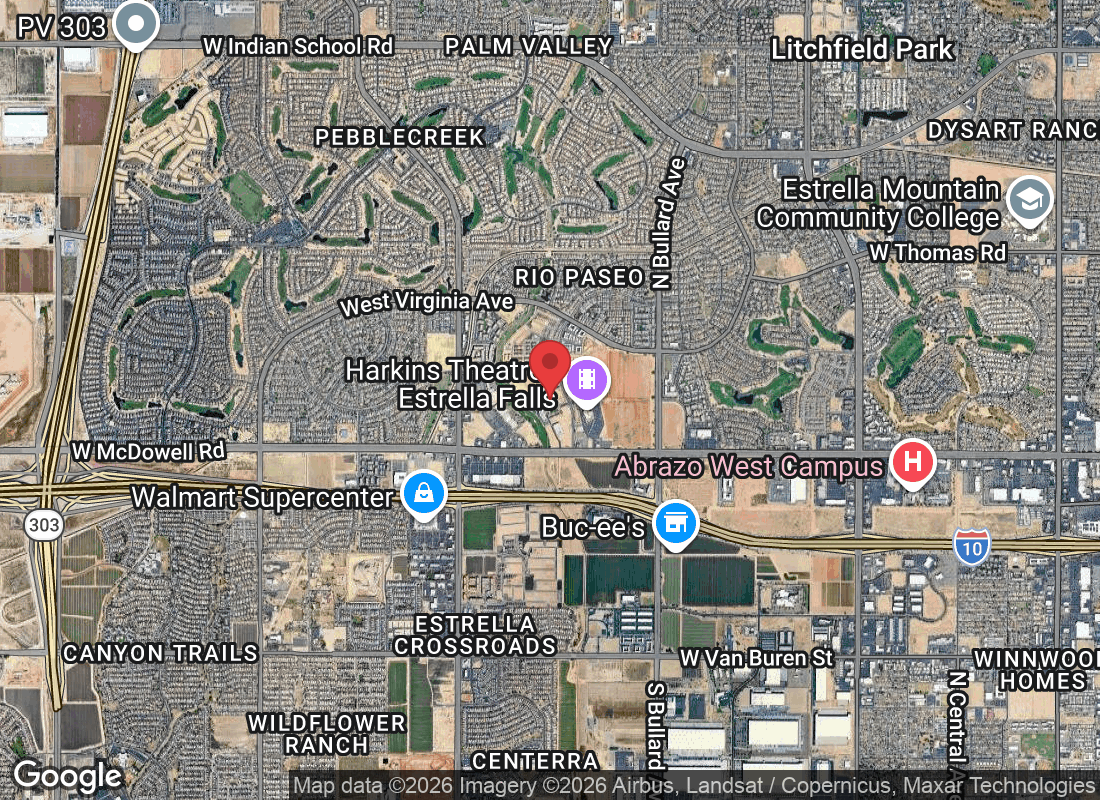
EstablishedPalm Valley sits in the northeast section of Goodyear, close to Estrella Falls and the Loop 303/I-10 interchange. It's one of the most accessible Goodyear communities for commuters heading into Phoenix or north toward Luke AFB. The area has a mix of older resale inventory and newer phases where new construction is still available on infill lots.
Palm Valley Golf Club is within the community boundary. Residents have quick access to Estrella Falls retail, multiple grocery anchors, and the full commercial strip along McDowell Road and Camelback Road.
Canyon Trails
Family-FocusedCanyon Trails is a well-regarded master-planned community in central Goodyear, known for its strong schools, extensive parks, and trail system. The community has a distinct family character — planned around a network of neighborhood parks connected by pedestrian paths, with the canyon wash serving as a green-space spine through the development.
New construction phases remain active here. The community is close to Goodyear's best-regarded elementary schools and offers a walkable neighborhood feel that is less common in sprawling desert developments.
Prasada (Surprise)
Active New BuildTechnically in Surprise, Prasada is immediately north of Goodyear along the Loop 303 corridor and draws buyers who want a newer, larger community with extensive amenities. The master plan is one of the most ambitious underway in the West Valley — multiple villages, resort-style amenity centers, and a large retail component anchored by Prasada retail center on the Loop 303.
Buyers considering Goodyear for Luke AFB access, medical employment, or general West Valley location often look at Prasada in the same search. It offers similar commute access via Loop 303 and is roughly 10 miles from central Goodyear.
Skyline Ranch
Active New BuildSkyline Ranch straddles the Surprise/El Mirage border north of Goodyear, with quick access via Loop 303 to both Luke AFB and the western I-10 corridor. The community is known for larger lots relative to many newer West Valley developments and continues to see active new construction across multiple price points.
The northern West Valley communities like Skyline Ranch attract buyers who want more breathing room on their lot without paying Scottsdale premiums, and who commute primarily via Loop 303 or the I-17/303 interchange north of town.
Buckeye New Builds
West of GoodyearBuckeye borders Goodyear directly to the west along I-10 and is one of the fastest-growing cities in the country by percentage. Buyers who want new construction at a lower entry price point — and who don't mind being 10 to 15 minutes further from Phoenix — often find compelling options in Buckeye's active new-build communities. Verrado, Tartesso, and Festival Ranch are the most established; newer phases continue expanding west.
Verrado in particular has a strong Main Street commercial core, a historic town-center feel, and an active community association. It's worth including in any Goodyear-area search.
The Relocation Timeline: From First Search to Move-In
New construction in Goodyear typically takes 5 to 8 months from contract signing to closing, with 6 months as the common working estimate. That build window is actually an advantage for out-of-state buyers — it gives you a defined runway to prepare everything on your end. The key is understanding how your pre-move tasks sequence against the builder's construction schedule.
Initial Research and Community Selection
This is the phase most buyers start from their couch — and the most important one to do thoroughly before flying out. Research the communities that match your priorities (school district, commute, price range, lifestyle). Use Google Street View, community websites, and builder websites to narrow down. Read HOA documents for any community you're seriously considering.
- Identify 2 to 4 communities that match your criteria
- Research school district boundaries for each
- Understand which builders are active in each community
- Connect with a buyer's agent before visiting — the on-site rep works for the builder
Financing Pre-Approval
Get pre-approved before you tour a single model home. Builders will take you more seriously, and you'll have leverage in negotiations. Compare your own lender against the builder's preferred lender — builder lenders sometimes offer incentives (closing cost credits, temporary rate buydowns) but are not always the most competitive on rate. Understand how extended rate-lock programs work for new construction, since you won't be closing for 5 to 7 months.
- Obtain pre-approval from at least one outside lender
- Ask each builder about their preferred lender incentives
- Understand extended rate-lock and float-down options
- Get clear on your construction deposit requirements (typically 1–10% earnest money)
Site Visit, Lot Selection, and Contract
If possible, visit Goodyear in person before signing. Tour 2 to 3 communities, walk available lots, and compare model homes. Your agent should accompany you or, if you can't fly out, help you evaluate lots and floor plans remotely using satellite imagery, community maps, and their on-the-ground knowledge. Once you've selected your community, floor plan, and lot, contract signing begins the official build clock.
- Walk all available lots in your target community before selecting
- Review the purchase contract thoroughly with your agent before signing — pay attention to delay clauses, earnest money terms, and upgrade addenda
- Make design center selections (structural options, flooring, counters, cabinetry) typically within 30 days of signing
- Make your earnest money deposit per contract terms
Foundation, Slab, and Framing
The builder breaks ground, pours the foundation and slab, and begins framing. This is often the most visually exciting phase — your lot goes from dirt to a recognizable structure quickly. Cinda visits the site during framing and sends photos and video so you can see the progress from wherever you are.
- Begin researching schools and enrollment requirements for your district
- Start decluttering and preparing your current home for sale if you own
- If renting currently, give your landlord proper notice per your lease
Rough Mechanicals and Pre-Drywall
Plumbing, electrical, HVAC, and framing inspections happen before walls are closed. This is the single most important phase to have an independent inspector involved. A pre-drywall inspection can identify framing errors, plumbing rough-in issues, or missing insulation that would be expensive and disruptive to correct after drywall goes up. Cinda coordinates this inspection and walks the site with your inspector if you can't be there in person.
- Schedule your independent pre-drywall inspection — do not skip this
- List your current home with a local agent if you are selling
- Continue rate monitoring; consider locking if your lender advises it
Drywall, Interior Finishes, and Systems
Drywall goes up, paint is applied, flooring is installed, cabinets and counters go in. The home starts to look finished well before it is. Your selections from the design center come to life during this phase. Cinda photographs progress at key milestones — especially once your flooring and cabinetry are in — so you can verify your selections are correct before closing.
- Confirm your current home sale is on track or arrange bridge financing if needed
- Research moving companies and get at least 3 quotes — good long-distance movers book out weeks in advance
- Begin the Arizona driver's license and vehicle registration process if needed
- Contact your children's new school about enrollment requirements
- Research Arizona homeowner's insurance — carriers and premiums differ significantly from other states
Final Inspection, Walkthrough, and Closing
The builder requests a Certificate of Occupancy once construction is complete and all city inspections pass. You'll have a final walkthrough (orientation) with the builder, followed by closing. Schedule your own independent inspector for a final inspection before closing — even brand-new homes have issues that are far easier to address as a warranty item before you take title than after. Cinda accompanies you through the walkthrough and helps document any items on your punch list.
- Schedule an independent final inspection before your builder walkthrough
- Review all closing documents carefully — confirm your loan terms match what was quoted
- Confirm your homeowner's insurance is bound and effective at closing
- Finalize mover booking and confirm your move-in date
Move-In, Arizona Registration, and Warranty Period
Once you have keys, the builder's warranty period begins. Most Arizona builders offer a one-year workmanship warranty, a two-year systems warranty (mechanical, plumbing, electrical), and a ten-year structural warranty. Document any warranty items immediately — photograph issues and submit them in writing per the builder's warranty process. Your agent can advise on what qualifies and how to escalate if the builder is unresponsive.
- Submit warranty items in writing within the first 30 days
- Complete Arizona vehicle registration (within 15 days of establishing residency)
- Obtain Arizona driver's license if you haven't already
- Update voter registration, banking addresses, and professional licenses as required by your state and profession
- Connect utilities (APS or SRP for electricity, Southwest Gas, city water/sewer) — your agent can confirm which serve your specific address
- Set up your HOA account and review CC&R rules for your community
Why You Need Your Own REALTOR® When Buying New Construction
The single most common mistake out-of-state new-build buyers make: walking into a model home without representation and dealing directly with the builder's sales team. Here's what you need to understand before you step foot in a sales office.
The Builder's Rep Works for the Builder
The on-site sales representative at every new-home community in Goodyear is employed by the builder. They are professional, often friendly, and genuinely knowledgeable about their product — but they represent the builder's interests, not yours. They are not obligated to tell you about defects in a lot, to negotiate on your behalf, to flag unfavorable contract terms, or to compare the builder's incentives to what competitors are offering.
This isn't a criticism of the sales reps — it's simply how the transaction is structured. Understanding that structure is the first step to protecting yourself.
It Typically Costs You Nothing
In the vast majority of new-construction transactions in Goodyear, the builder pays the buyer's agent commission. You get professional representation at no additional cost. Some builders have modified their co-op arrangements post-NAR settlement — Cinda will tell you exactly how this applies to any specific builder before you visit their community, and will be transparent if there is any cost involved. The answer is almost always: there isn't.
You Must Register Your Agent on the First Visit
Builder contracts in Arizona almost universally require that your agent be identified and registered on your first visit to a sales office or model home. If you tour a community without registering your agent and later decide to purchase, you may lose the ability to have representation. If you are working with Cinda, let the sales office know when you first make contact — even if it's a phone call or an online inquiry.
What a Buyer's Agent Does in a New-Build Transaction
- Reviews and explains the purchase contract and all addenda before you sign — builder contracts are written to protect the builder, not you
- Compares incentive packages across multiple builders and communities so you can make an apples-to-apples decision
- Negotiates lot premiums, upgrades, and closing cost contributions — even with production builders, there is almost always room to negotiate
- Advises on lot selection with knowledge of drainage patterns, orientation, adjacent land use, and community-specific considerations
- Coordinates independent inspections at pre-drywall and final walkthrough stages
- Reviews the design center upgrade list and advises on what has good resale value vs. what you can do more cheaply after closing
- Documents punch list items at the final walkthrough and follows up on warranty items
- Serves as your local eyes and ears if you are purchasing from out of state and can't be present for every phase
What Cinda Sends You During the Build
Foundation & Slab
Photos of your lot after grading, before and after the pour.
Framing
Walkthrough video showing room layout, window placements, and structural elements.
Pre-Drywall
Photos of plumbing, electrical, HVAC rough-in — before walls close. Inspection coordination at this phase.
Interior Finishes
Photos of your flooring, cabinetry, and counters installed so you can verify your design selections.
Final Walkthrough
Video walkthrough of the completed home before closing, with punch list documentation.
You shouldn't have to fly to Arizona to know what's happening with your home.
Cinda keeps out-of-state buyers informed throughout every phase of the build — with photos and videos at each milestone, so you can watch your home go up from wherever you are.
Start the ConversationNew Construction vs. Resale in Goodyear
Both paths have merit. The right choice depends on your timeline, priorities, and how you weigh certainty against flexibility. Here's an honest comparison.
| Factor | New Construction | Resale |
|---|---|---|
| Timeline | 5–8 months from contract to close | 30–45 days from contract to close |
| Customization | Choose floor plan, finishes, structural options | Take the home as-is, renovate after |
| Condition | Brand new; builder warranty in place | Varies; independent inspection critical |
| Energy efficiency | Modern systems, better insulation, lower utility costs | Depends on age and updates |
| Price predictability | Contract locks your price; material costs change but price is fixed | Subject to appraisal and market conditions |
| Negotiating room | Limited on price; stronger on incentives, upgrades, lot premiums | Direct price negotiation; repairs after inspection |
| Landscaping | Typically minimal; you design from scratch | Often established; trees take years to grow |
| Community maturity | Construction ongoing nearby; dust, noise, trucks | Finished neighborhood, established neighbors |
| HOA | Almost universal in new West Valley communities | Present in many established communities too |
| Agent representation | Essential — builder's rep is not your advocate | Essential — standard buyer representation |
Meet Cinda Rose
West Valley new-construction specialist. Realty ONE Group. Based in Goodyear.

Cinda Rose
West Valley New Construction Specialist | Goodyear, Arizona
Cinda focuses exclusively on new-construction and new-build buyers in the West Valley. She works with relocation buyers from out of state every week — people who are purchasing a home they may not see in person until the final walkthrough, in a city they're still getting to know.
She knows the builders active in Goodyear, Buckeye, Surprise, and Avondale — their construction quality, their contract terms, their warranty processes, and how much room each one leaves for negotiation on upgrades, lot premiums, and incentives. She knows which communities fit which buyers and which lots to avoid.
For buyers who are hundreds or thousands of miles away, Cinda provides regular photo and video updates at each build phase — foundation and slab, framing, pre-drywall, mechanicals, interior finishes, and final walkthrough — so you can see what's happening with your home without getting on a plane.
- 623-252-9350
- [email protected]
- 15150 W Pk Pl Suite 315, Goodyear, AZ 85395
- Realty ONE Group
Out-of-State Buyers
Most of Cinda's clients are relocating from California, Oregon, Washington, Colorado, the Midwest, or the East Coast. She's familiar with the questions, concerns, and timelines that come with a long-distance purchase, and she structures her communication around keeping you informed at every phase without requiring you to ask.
Phase-by-Phase Updates
Cinda personally photographs and videos each significant phase of your build — foundation, framing, pre-drywall, finishes, and final walkthrough — and shares them with you directly. If something looks off or needs to be documented, she catches it while there's still time to address it.
Builder Knowledge
Knowing which builders are offering the most competitive incentive packages right now, which contracts are tightest on delays, and which floor plans hold their value in each community is the kind of knowledge that comes from doing this every day in the West Valley — not from reading builder websites.
Contract and Negotiation
Builder purchase contracts are written to protect the builder. Cinda reviews them line by line with her buyers, flags terms that are worth pushing back on, and negotiates on upgrades, lot premiums, and closing cost contributions. Even production builders who say their pricing is fixed almost always have some flexibility on the right items.
FAQ: Relocating to Goodyear and Buying New Construction
The questions Cinda gets most often from out-of-state buyers — answered directly.
No, in the vast majority of cases. Builders in the Goodyear area have historically paid the buyer's agent commission as a standard part of doing business — you get professional representation at no additional cost to you. Following industry changes in 2024, some builders have adjusted how they structure co-op compensation. Cinda will tell you upfront, before you visit any community, exactly how each builder handles buyer representation and whether there is any cost to you. The answer is almost always that there is no cost to you.
The more important point: the builder's on-site rep is employed by the builder. They represent the builder's interests. Having your own agent changes the dynamic of the entire transaction, and it typically costs you nothing.
Yes, with conditions. Most builders' preferred lenders offer extended rate-lock programs — sometimes 6 to 12 months — specifically designed for new construction timelines. These programs often include a one-time float-down option if rates drop during the build period.
Builder lenders sometimes offer attractive incentives: closing cost credits, temporary rate buydowns, or below-market programs tied to the builder relationship. These are worth evaluating carefully. However, you are not required to use the builder's preferred lender, and you should compare their rate and total cost against at least one outside lender before committing. Your agent can help you evaluate both options fairly.
Builder contracts in Arizona typically give the builder a wide window to complete construction and limit the buyer's remedies for delays. This is one of the most important reasons to have your own agent review the purchase contract before you sign. Look for: how the delay clause is worded, whether there is a maximum delay period, what your remedies are if the builder misses that date, and whether your earnest money is at risk if you need to exit due to an extended delay.
In practice, most Goodyear builders stay close to their estimated completion windows, but supply chain disruptions, labor shortages, and permit delays can extend timelines. Planning your lease, mover booking, and current home sale with some built-in flexibility is advisable. A per-diem credit clause for extended delays is worth negotiating if the builder will accept it.
Both approaches are common and both can work depending on your situation. If you're signing a new-build contract, the 6-month construction window gives you a natural bridge period — you can rent locally while your home is being built, get to know the area, and avoid a rushed decision on the community or school district. The tradeoff is a double move and the added expense of a short-term lease.
If you're confident in your community and floor plan choice, buying directly from out of state is common and workable with the right agent keeping you updated. Many of Cinda's clients close on a new home without ever having lived in Arizona — they do their research thoroughly, visit the site once or twice during the build, and rely on Cinda for the day-to-day oversight.
Renting first is generally advisable if you're uncertain about which part of the West Valley you want to be in, or if your timeline is flexible enough to allow it.
Absolutely. New homes have defects — sometimes significant ones. City inspectors do their jobs, but they are checking for code compliance, not client advocacy. Builder walkthroughs are orientation tours, not inspections.
The two inspections that matter most in a new-construction purchase:
- Pre-drywall inspection: Conducted while the walls are still open, this lets an independent inspector verify that framing, plumbing rough-in, electrical wiring, and HVAC ductwork are correct. Defects found here are relatively inexpensive to correct. Defects found after closing, once walls are closed and finished, are not.
- Final inspection: Conducted shortly before closing, after the builder's completion walkthrough. Catches finish work defects, incomplete items, and anything the builder's walkthrough missed. Documenting issues before you take title gives you more leverage in getting them resolved.
The cost of two inspections is a fraction of the cost of even a minor post-closing repair. This is not optional.
Generally worth paying for at the design center:
- Structural options — extended garage, added bedroom or bathroom, bonus room, covered patio extension, RV gate. These cannot be added later without major expense.
- Pre-plumb for water softener loop — costs $200–500 at build time, significantly more to retrofit.
- Gas stub-out for outdoor grill and fire pit in the backyard.
- Soft-close cabinetry upgrades if you use kitchen cabinets frequently — this is cosmetic but high-use.
- Electrical upgrades: dedicated circuits, extra outlets, EV charger rough-in in the garage.
Often worth skipping or doing after closing for less:
- Builder-tier flooring upgrades — aftermarket flooring installation is often more competitively priced.
- Cabinet hardware — easily replaced.
- Countertop tier upgrades above mid-grade — check what comparable homes in the community have before paying a premium here.
The rule of thumb: pay for things that are structural or in-wall at build time, and defer things that sit on surfaces and can be swapped out after closing. Your agent can review your specific design center price sheet and advise on what's worth it relative to the community's resale ceiling.
Lot selection is one of the decisions buyers most consistently underestimate. A few things to evaluate:
- Orientation: In Arizona, a south-facing backyard means your home's rear elevation faces south, which means the structure shades the backyard in the afternoon — critical for pools and outdoor living. North-facing backyards get afternoon sun exposure directly. This is the single most discussed lot characteristic among Phoenix-area buyers.
- Adjacent land use: What's behind you, to the sides, and across the street? Retention basins (necessary for flood control), utility transformers, commercial pad sites, or planned collector roads can all affect livability and resale value.
- Size and shape: Pie lots (wider in the back) give more usable yard space than rectangular lots of the same square footage. Corner lots have street exposure on two sides. Cul-de-sac lots typically have less traffic but may have irregular shapes.
- Premium lots: Greenbelt lots, cul-de-sac lots, and lots backing to mountain preserve or open space carry premiums — and tend to hold their value well at resale.
- Future phases: If the community is still building, understand what will eventually be built adjacent to your lot. Phase maps show what's planned; don't assume adjacent empty land will stay empty.
Your agent should walk the site with you — in person or via virtual walkthrough — before you select. Don't rely solely on the builder's site map.
Most new Goodyear communities have an HOA. Many master-planned communities have two: a master HOA for the overall development and a sub-HOA for your specific village or phase. Fees range widely — from roughly $50 per month in simpler communities to $300 or more in amenity-heavy master plans with resort pools, fitness centers, and extensive landscaping.
Before signing any new-build contract, ask your agent to request the HOA documents: the CC&Rs (Covenants, Conditions & Restrictions), the HOA bylaws, the current budget, and the reserve study. Key things to review:
- What the HOA fees actually cover vs. what you pay separately
- Rental restrictions — relevant if you may want to rent the home short- or long-term
- Any special assessments currently approved or under discussion
- Reserve fund health — an underfunded reserve means future special assessments are more likely
- Rules on exterior modifications, parking, and landscaping
In large master plans like Estrella, the master HOA maintains lakes, trails, and community centers; the sub-HOA maintains common areas within your village. Both fees apply. Neither is optional.
New-construction pricing in Goodyear spans a wide range depending on builder, community, square footage, and lot premium. Entry-level production builders (D.R. Horton, Richmond American, Beazer) typically start in the low-to-mid $300s for smaller floor plans in developing areas. Mid-tier builders (Meritage, Pulte, Taylor Morrison) generally run from the mid-$300s into the $500s for standard configurations. Premium builders (Toll Brothers, David Weekley) and larger floor plans in established communities like Estrella can run from the high $400s into the $700s and above.
Design center upgrades, lot premiums, and structural options add to the base price — often by $30,000 to $100,000+ in fully optioned homes. It's important to compare total contract price (base + lot premium + upgrades) rather than advertised base prices when comparing builders.
These are approximate ranges based on current market conditions and are subject to change. For current pricing and availability in specific communities, contact Cinda directly.
Cost of Living: What to Expect When You Move to Goodyear
One of the most consistent motivations for relocating to Goodyear from California, Oregon, or Washington is the difference in housing cost per square foot. Here's what that comparison actually looks like — and where Arizona costs more than you might expect.
Where Arizona Costs Less
- Housing: New construction in Goodyear at similar square footage and finish quality typically runs significantly less than comparable new homes in California coastal markets, the Pacific Northwest, or the Denver metro. Buyers regularly report 30 to 50% more house for the same money compared to their origin market.
- Property taxes: Arizona property taxes are generally moderate by national standards. Effective rates in Maricopa County typically run in the 0.6 to 0.9% range of assessed value, which is lower than most California, Illinois, New Jersey, or New York rates.
- State income tax: Arizona's flat income tax rate is lower than California's graduated rates, which is a meaningful difference for high earners relocating from the West Coast.
- No state estate tax: Arizona does not have a state estate or inheritance tax.
- Overall consumer prices: Groceries, dining, and general services tend to be modestly lower than California metro markets.
Where Arizona Costs More (or Surprises People)
- Electricity (cooling): This is the big one. Summer electric bills for a 2,000–3,000 sq. ft. home in Goodyear can run $250 to $400+ per month during June through September. APS and SRP are the two primary utilities; their rate structures differ. A home with good insulation, proper orientation, and an efficient AC system mitigates this significantly. Ask about HERS ratings when comparing builders.
- Pool costs: A large percentage of Goodyear buyers install pools. Installation ranges from roughly $40,000 for a basic pool to $80,000+ for custom builds. Monthly maintenance adds another $100–200. Factor this in if outdoor living is a priority.
- Window treatments: Desert sun requires blackout and solar shades on most windows. Budget $3,000–8,000 for a new home depending on size.
- Water softener and filtration: Goodyear's water is hard. Most homeowners install a whole-house water softener ($800–2,500 installed). Pre-plumbing for this at build time is much cheaper than retrofitting.
- HOA fees: Master-planned communities carry ongoing HOA costs. Factor these into your monthly housing budget.
Ready to Start Your Search?
Whether you're six months out from your move or ready to fly to Goodyear this weekend, Cinda can tell you what's available right now, what to expect from the process, and what it actually costs. No obligation, no pressure — just straight answers from someone who does this every day in the West Valley.
Start Your Search
Tell us a little about where you are in the process and what you're looking for.
Information on this page is provided for general guidance and educational purposes. Builder availability, pricing, incentive programs, school district boundaries, and HOA terms change frequently and should be independently verified before making any purchasing decision. Cinda Rose is a licensed REALTOR® with Realty ONE Group in the State of Arizona. © WV New Builds. All rights reserved.

Realty ONE Group Goodyear
Contact
©2026 Copyright CINTO LLC and The West Valley Home Team. All Rights Reserved.